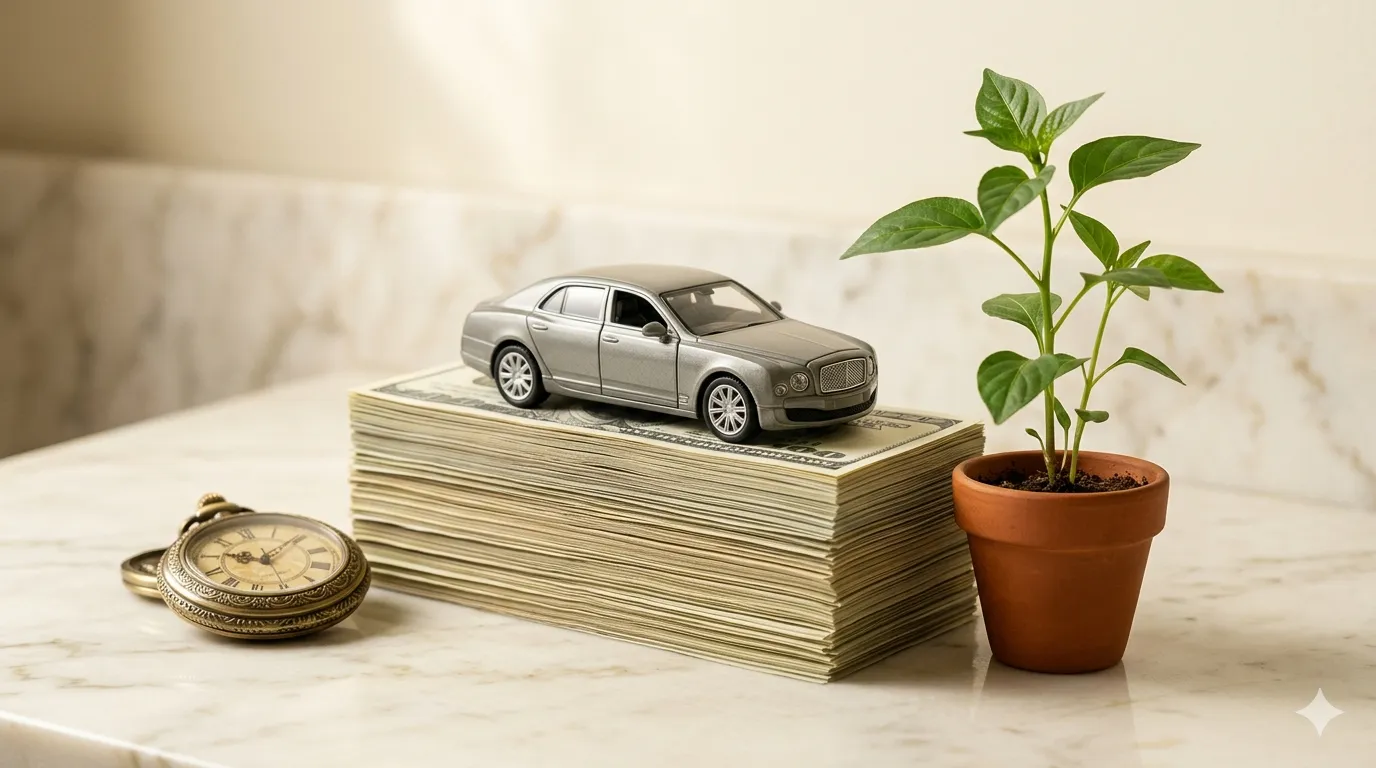
The sticker price is the smallest number in the deal
A car costs more than its price tag. It costs the price tag — plus everything that money could have become if you hadn’t spent it. Economists call that opportunity cost. I call it the most expensive blind spot in personal finance, because cars are where ordinary people quietly hand over fortunes without ever noticing.
I’m not here to tell you never to buy a nice car. I’m here to show you the real number — so that when you do, you’re choosing it on purpose.
The number nobody shows you
Say you’re deciding between two cars that both get you to work, safely and reliably: a $40,000 new one and a $20,000 used one. The “cost” of the nicer car looks like the $20,000 difference. It isn’t.
Invest that $20,000 instead, at the market’s long-run ~10%, and in 30 years it’s worth about **$349,000.**¹
So the real price of the upgrade isn’t $20,000. It’s a third of a million dollars of future you. Same commute, every morning — one version just costs about 17× more than it looks.
Here’s the rule of thumb worth tattooing somewhere: at ~10% over 30 years, every $1 you don’t overspend today becomes about $17 later. A $5,000 splurge is really an ~$87,000 decision. A $20,000 one is a down payment you’ll never get to make.
The habit is worse than any single car
It compounds a second way, too. Most people don’t buy one expensive car — they trade up to a new one every five or six years, for their whole working life. It’s not a single $20,000 decision; it’s the same decision, eight or nine times over, each one quietly skimming six figures off your future. The treadmill, not the car, is what gets you.
What I actually do — and what I’m not saying
I’m not telling you to drive a beater. A cheap, unreliable car that strands you and bleeds you in repairs is a false economy — penny-wise and pound-foolish, the opposite of value. Safety isn’t negotiable. A car is a tool, and a good tool earns its keep.
Here’s what it looks like with my own money. I drove a Toyota Yaris from 2009 to 2025 — bought new for about CAD $18,000, sold sixteen years later, at 196,000 km, for about $6,000. Across those sixteen years I spent maybe $4,000–$5,000 total on maintenance — oil changes, brakes, and that’s it. The thing was indestructible. All in, that’s roughly $16,500 of true cost over sixteen years — about $1,030 a year to own a car that never once let me down.
When it was time to replace it in 2025, I did the same thing again: a Toyota Corolla Cross, bought for the same boring reason — reliability — and paid for in cash. No lease, no loan, no payment skimming my future.
A note before anyone asks: this isn’t a Toyota endorsement. It’s personal experience — sixteen years with one Yaris, then a Corolla Cross. I have no relationship with Toyota or its affiliates, no sponsorship, no compensation. I don’t even use Toyota dealerships for maintenance (in my experience their service prices don’t match the value — an independent shop has been cheaper and just as good). Honda, Mazda, Subaru, and a handful of others would work just as well for the same reasons. What I’m endorsing is the boring-and-reliable strategy, not the badge.
I also bought gas, not electric — in 2025, when I made the call, the premium to own an EV didn’t pencil out for my situation. (I won’t say “for most buyers” — see the next sentence.)
An aside that surprised me: I sat down to run today’s numbers — Tesla Model Y RWD vs. Toyota Corolla Cross XLE AWD, 10 years, 20,000 km/year, current MSRPs and national-average fuel/electricity — expecting to confirm the old “EV is a statement, not economics” framing. Instead I found the gap has nearly closed: in Canada the EV is now essentially break-even with the gas car over a decade; in the U.S. it’s only ~$7K more — less than ten years of a daily Starbucks habit. Eighteen months of Tesla price cuts plus rising gas prices have made the environmental statement genuinely affordable. Full breakdown next week.
The pattern underneath all of it: buy the reliable car, not the impressive one; hold it for years; pay cash if you can; and invest the difference. Let the car get you to work, and let time get you rich.
Because here’s the thing: a car is a depreciating asset you feed money. An index fund is an appreciating one that feeds you. Most “car decisions” are really a quiet vote on which of those two you’d like more of.
What’s the most a car ever cost you — the sticker price, or the thing you didn’t invest? Tell me in the comments.
¹ Assumes the difference invested as a lump sum at ~10% compounded annually for 30 years, before taxes and fees — illustrative, not a forecast. Shorten the horizon or lower the return and the number shrinks, but the lesson holds.
Seek Value Now is published for educational and informational purposes only and is not investment advice. Do your own research before investing. — HG