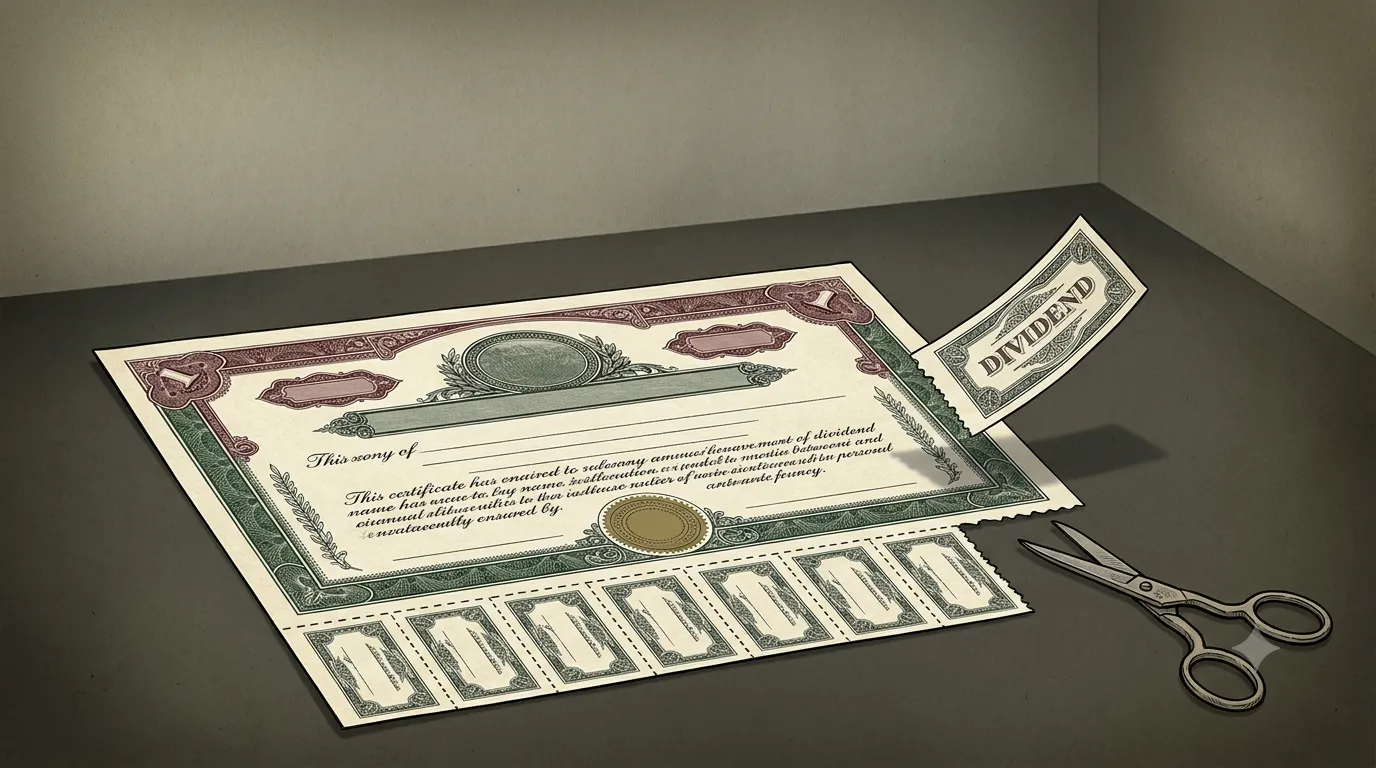
A dividend is not a check from the universe. It’s a sale — and a signal about what management thinks they can do with the next dollar of your money.
A reader wrote in last month asking which “high-yield” stocks I’d buy for income — five percent, six percent, “real cash flow.” The honest answer starts a few steps earlier than most people think.
A dividend is not free money. It’s something more interesting — and once you see it for what it is, you’ll read every dividend announcement differently.
The mechanic nobody explains
On the ex-dividend date, the stock price drops by approximately the dividend amount. If XYZ pays a $1.00 dividend and was trading at $50.00 the day before, it opens around $49.00. The exchanges do this mechanically — not a market reaction, an accounting reality. The cash just left the company.
So what actually happened? You started with a $50 share. You end with a $49 share and $1.00 in cash. Pre-tax, you have exactly what you had before. Post-tax, you have less — because in most accounts that $1.00 is now a taxable event.
The transaction is mathematically equivalent to the company forcing you to sell a tiny slice of your position back to itself, with tax applied to the proceeds. That’s the trade. There is no free dollar. If you’d sold $1.00 of XYZ yourself, you’d be in the same place — minus the tax timing, which you’d at least control. The dividend takes that decision away from you.
Most people don’t notice because the share price recovers — or doesn’t — on news and earnings in the days that follow, and the $1.00 drop gets buried in the noise. But on the day, the math is unambiguous.
A short detour: why dividends exist at all
The dividend isn’t an accident of finance — for centuries it was the only credible way for a company to return value to its owners. In the 1700s and 1800s, stock exchanges were thin and audited disclosure didn’t exist. There was no 10-Q to trust, no SEC, no reliable continuous price. The dividend was the proof the business was real: if the company paid you cash, it existed and was making money. If it didn’t, you had a piece of paper and a story.
The case stayed strong through most of the 20th century for two practical reasons. Share buybacks — the cleaner mechanical alternative — were legally fraught in the U.S. until the SEC adopted Rule 10b-18 in 1982. And trading was expensive: $50–$100 commissions per ticket meant manufacturing your own income by selling shares cost real money. The dividend solved a real friction problem.
Almost none of that holds today. Trading is free or near-free; fractional shares let you sell any dollar amount; buybacks are now the dominant way mature U.S. companies return cash (S&P 500 buybacks have exceeded dividends in most years since the early 2000s); and audited disclosure handles the verification job. The signal a dividend was originally designed to send — we are real, here is proof in your hand — your brokerage account already gets in a hundred other forms. What’s left of the tradition is mostly inertia and the income-mandated shareholder base it has attracted. And for a growth company with a real reinvestment runway, paying out a dollar that could be compounding at 20% inside the business so a shareholder can park it in a money-market fund at 5% isn’t returning value. It’s destroying it.
And it gets worse after tax
Go back to the $1.00 dividend on the $50 stock. In a taxable account, that dividend triggers a tax bill this year, on cash you didn’t ask for. The specifics vary by country, by bracket, and by whether the dividend qualifies for preferential treatment — but the general rule holds across jurisdictions: outside of sheltered accounts, dividends are taxed at a higher effective rate than capital gains. On top of that, a dividend forces the tax now, while an unrealized capital gain lets you defer until you choose to sell. So two companies that deliver the same $1.00 of total return — one as a dividend, one as appreciation — are not equivalent after tax. The dividend version costs more, and the gap widens with your time horizon. (In sheltered accounts — TFSA, RRSP, IRA, 401(k) — this gap largely disappears.)
So what IS a dividend, then?
If it isn’t free money, what is it? It’s two things at once.
A payout decision. Management has cash. Their options: reinvest in the business, buy back stock, pay down debt, pay it out, or sit on it. Each is a bet. Paying the dividend is the bet that says: we cannot earn a higher return on this dollar inside the business than you can earn with it outside.
And therefore a signal. A company paying a hefty dividend is, in effect, admitting: “we couldn’t find anything better to do with this.” Whether that’s an honest admission or a defensive one is the question you’re actually evaluating — and the same dividend can mean very different things from two different companies.
When the dividend is honest
There are companies whose growth runway is genuinely behind them. Mature consumer staples. Big regulated utilities. Old-line industrials whose markets grow at GDP and whose competitive position is stable. They generate consistent cash and they truly don’t have a better use for the next dollar than to hand it back.
For these companies the dividend is an honest signal: we’re a cash machine, not a growth story, and we know it. The retiree who needs predictable income and doesn’t want to make selling decisions every month is buying that cash flow consciously, and the dividend is doing its job. Notice that these companies don’t grow the dividend aggressively — they grow it roughly in line with their (modest) earnings growth. The payout is honest because the business is honest about what it is.
When the dividend is a warning
Now contrast with three flavors that should make you uneasy:
1. The “growth” company that pays a dividend. If management talks at every quarterly call about huge addressable markets, new platforms, and reinvestment opportunities — and also pays out a quarter of its cash as dividends — one of those stories isn’t true. You don’t get to claim both “we have great places to put this money” and “here, you put it somewhere.”
2. The company that borrows to pay or grow the dividend. Most common in REITs but not unique to them. When the dividend exceeds free cash flow — or worse, when the company is issuing debt or shares to fund it — you’re not receiving “your” cash. You’re receiving borrowed money routed through your brokerage account on its way to creating future interest expense. Watch payout ratio against free cash flow, not earnings, and watch the long-term debt trend. If both are rising alongside the dividend, something has to give.
3. The company that can’t cut. Many mature companies preserve their dividend long past the point where it makes business sense, because their shareholder base is dividend-mandated — pension funds, dividend ETFs, income retirees — and a cut would force selling and a re-rating. The dividend stops being a capital-allocation decision and starts being a hostage situation. That’s not a great sign about who is actually running the company.
None of these is automatically a sell. But each is worth a second look.
The myth that dividend payers are “higher quality”
A persistent piece of folk wisdom holds that dividend-paying stocks are higher-quality than non-payers. The empirical record is more nuanced. Dividend growers — companies that have raised the dividend for decades — have had decent risk-adjusted returns, but that’s a selection effect: a company that can credibly raise its dividend for 25 years usually has a durable business. The quality is causing the dividend, not the other way around.
Plain “high-yield” stocks are a different category. Screen for the highest yields in the S&P 500 and you’ll often surface businesses in trouble — yields rise because prices fell on bad news, not because companies got generous.
And some of the best long-run compounders pay nothing at all. Berkshire never has — Buffett’s view is that a dollar retained inside Berkshire compounds better than one paid out, and the half-century record supports him. The big platform tech names did the same for most of the last twenty years and produced returns no income strategy came close to.
The lesson isn’t that dividends are bad. It’s that “pays a dividend” is not a quality signal by itself. What matters is the capital-allocation philosophy behind it.
So what should you actually do?
This isn’t a “don’t buy dividend stocks” piece. For some readers — retirees managing real cash-flow needs, anyone who genuinely prefers income to decision-making — dividend payers are the right choice. The point isn’t to avoid them. The point is to read them honestly.
- Treat the dividend as information, not income. A high payout is a confession about runway. A low or zero payout is a claim about runway. Decide which one matches what you see in the business.
- Check payout ratio against free cash flow, not earnings. Earnings can be massaged; cash is harder. If a company is paying out more than it’s bringing in, find out where the gap is being funded.
- Be skeptical of “we’re growing AND paying you cash.” That sentence usually has one true clause.
- Don’t conflate yield with safety. A 7% yield from a falling stock price is a warning, not a deal.
- Mind the account. Outside sheltered accounts, dividends are taxed at a higher effective rate than capital gains — and the bill comes this year rather than whenever you choose to sell. In a TFSA/RRSP/IRA/401(k) the gap mostly disappears, but most investors hold some equities outside the shelter, and that’s where it bites.
- Match life stage to your need. Want compounding? Look for businesses with real reinvestment runway — the kind that pays little or nothing because the dollar is worth more inside. Want income? Look for businesses whose maturity is honest — the kind where the payout matches the modest, durable reality of the business.
The reader who emailed me wanted yield. The honest answer is that yield is a feature, not a strategy — and the dividend on the front of a stock tells you almost nothing about whether you want to own the company behind it. Buy them awake.
Where do you fall on this? Income-first investor, total-return investor, somewhere in the middle? And if you’ve ever owned a high-yielder that cut — what did the year before the cut actually look like in the numbers? Drop it in the comments — these are the stories that teach the pattern better than any framework.
[INSERT SUBSCRIBE BUTTON HERE]
Seek Value Now is published for educational and informational purposes only and is not investment advice. Do your own research before investing. — HG