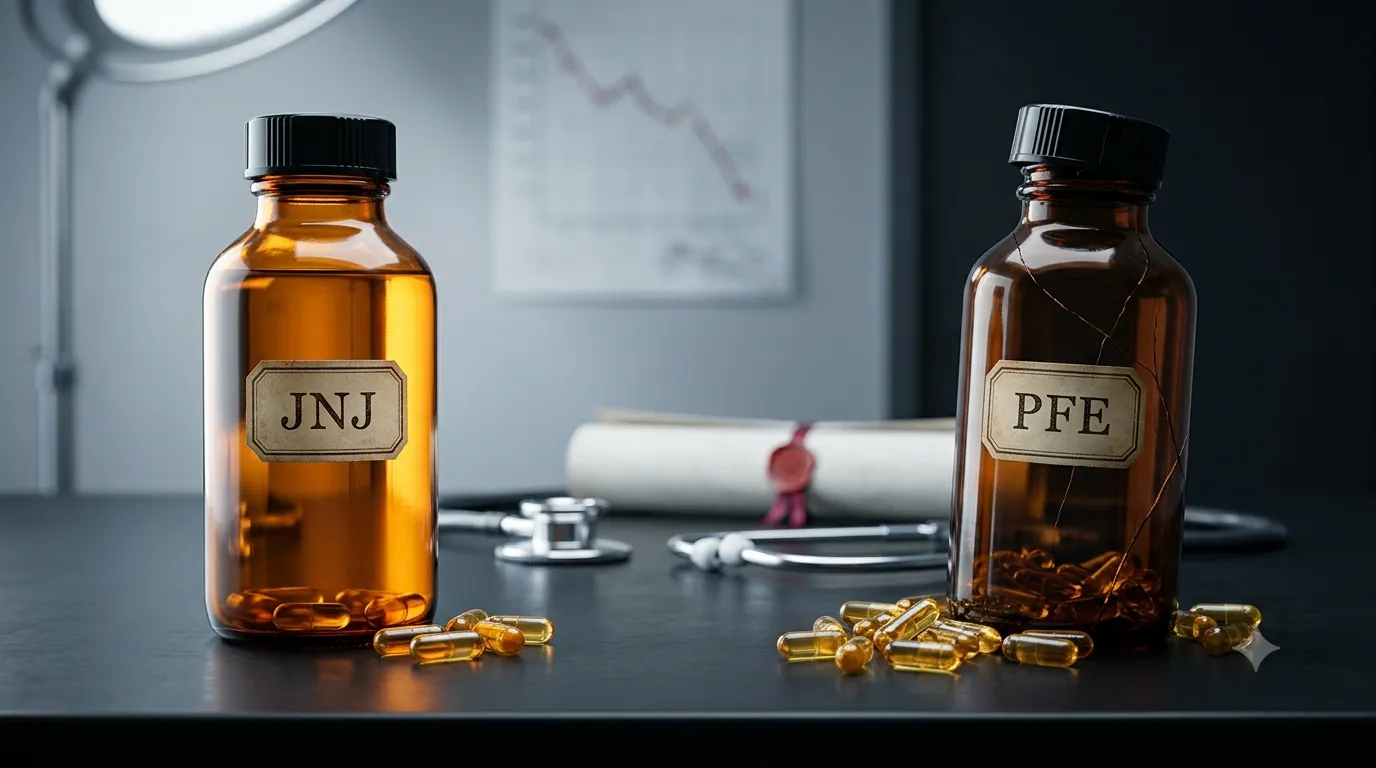
64 years of unbroken raises. A dividend bigger than the company’s earnings. Same industry, opposite signals.
Disclosure: I bought my first shares of Johnson & Johnson (JNJ) in April 2011 at $59.90. I added three more times over the years — 2018, 2019, and 2021 — at prices between $122 and $162. In January 2022 I sold about two-thirds of the position to help fund the down payment on a home. The remaining shares still compound. I have never owned Pfizer (PFE) — not one share, in fifteen years of active investing. Any fresh money I add to US pharma today goes to JNJ, not PFE. This is not a recommendation to buy or sell either. Full disclaimer at the bottom.
The setup: two weeks ago’s piece, made concrete
Two weeks ago I wrote that a dividend is not free money. It’s a signal about how management sees their own future. And the same dividend can mean very different things from two different companies. That piece described what an honest dividend looks like, and three flavors of warning dividend that should make you uneasy.
Today I want to show you the two clearest examples I could find in a single industry.
JNJ is what an honest dividend looks like. PFE is what a warning dividend looks like. Once you see the difference in these two companies — with real numbers — the framework from that piece stops being an abstract idea and starts being something you can use.
The short version
JNJ has raised its dividend every single year for 64 years. That’s one of the longest streaks in the entire stock market — only about fifty companies have raised for 50+ consecutive years. The most recent raise, this past April, was 3.1% — modest and credible. JNJ pays out roughly half of what it earns as dividends. The other half stays in the business. The dividend is doing its job: taking the steady profits of a mature healthcare business and turning them into predictable income for shareholders. This is the “honest” dividend from the earlier piece.
Pfizer has also raised its dividend every year for 17 years — but the raises have been tiny (about 2% a year on average). More importantly, Pfizer is now paying out $1.31 in dividends for every $1 of profit. That is not a typo. The dividend is bigger than the earnings. And this is happening right before Pfizer walks off a cliff — a bunch of their biggest drugs are about to lose patent protection over 2026 and 2027, which will cost them $17-18 billion a year in revenue. Every warning flavor from the dividends piece applies.
The stock market has already started pricing this. In 2025, JNJ went up about 45%. Pfizer went down 6%. The S&P 500 was up 13% for reference — JNJ crushed it, PFE lagged badly. On the surface Pfizer still looks cheap — you pay 8 dollars for every 1 dollar of last year’s Pfizer earnings, versus 26 dollars for every 1 dollar of JNJ earnings. But that “cheap” is priced for what everyone expects will happen next.
Fresh money to JNJ. I’ve been avoiding PFE for fifteen years, and today I still am.
The two businesses today (July 4, 2026)
Johnson & Johnson (JNJ) — $263 per share · market cap $633 billion
The world’s largest diversified healthcare company. Two years ago they spun off their consumer brands — Tylenol, Listerine, Band-Aid — into a separate company called Kenvue, which raised $13 billion for JNJ and left them focused on two things: prescription drugs (about 64% of the business) and medical devices (the other 36%). Their most recent quarter grew about 10% year over year. CEO Joaquin Duato took over from Alex Gorsky in 2022.
Pfizer (PFE) — $24 per share · market cap $146 billion
The COVID-era winner, now the post-COVID reset case. During the pandemic (2021-2022), Pfizer’s Comirnaty vaccine and Paxlovid antiviral pulled in about $57 billion in revenue at their peak — more than the entire rest of the company. Both have since collapsed to a fraction of that. This year Pfizer expects total revenue between $59.5 and $62.5 billion, and profit of about $2.80-3.00 per share. CEO Albert Bourla has been in the role since 2019 and has bet the company’s future on cancer drugs — over 40% of research spending now goes to cancer, especially after buying an oncology company called Seagen for $43 billion at the end of 2023.
Both are big, profitable, dividend-paying drug companies. The differences are about how durable each business actually is, not about what industry they’re in.
Before the numbers, the picture
Here’s what the two stocks have actually done. Both charts show JNJ’s price with Pfizer overlaid as the blue comparison line.
Trailing 3 years:
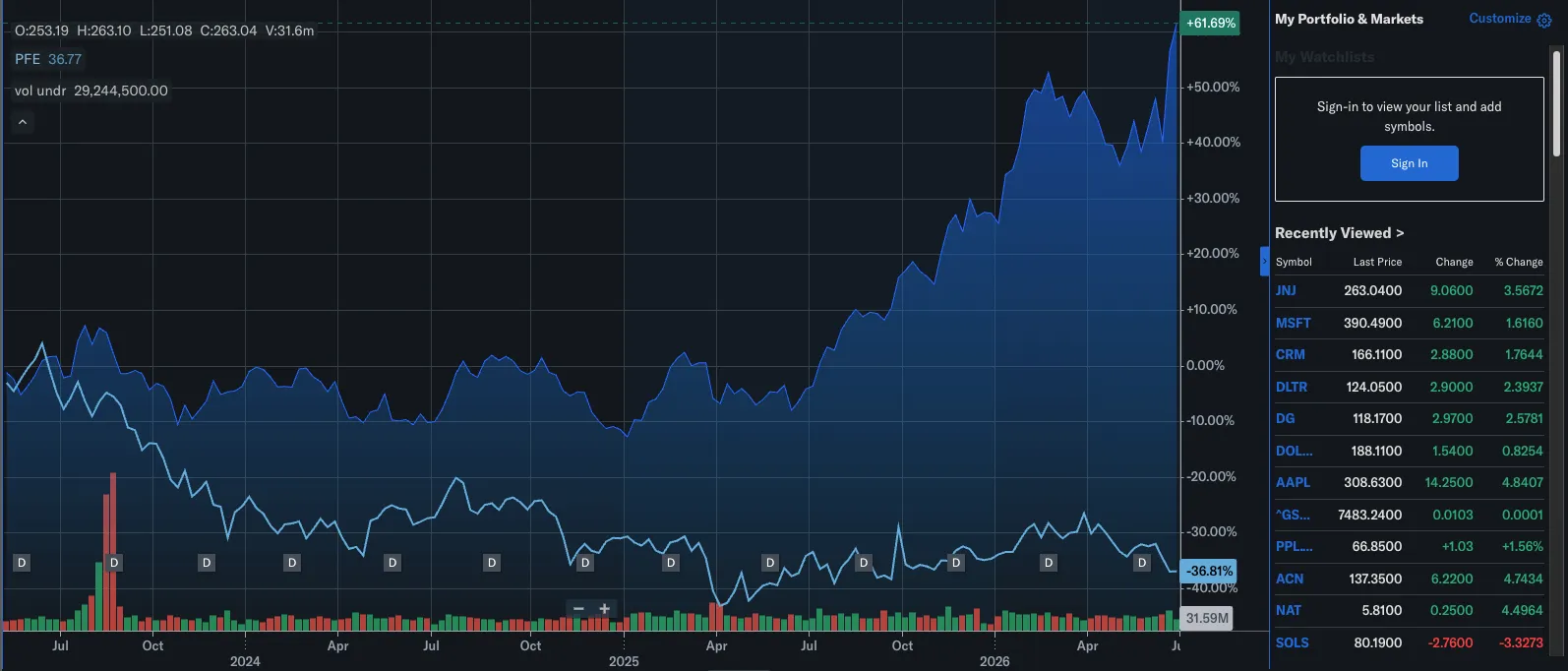
JNJ up about 51%. Pfizer down about 30%. A gap of ~80 percentage points between two companies in the same industry.
Trailing 5 years:
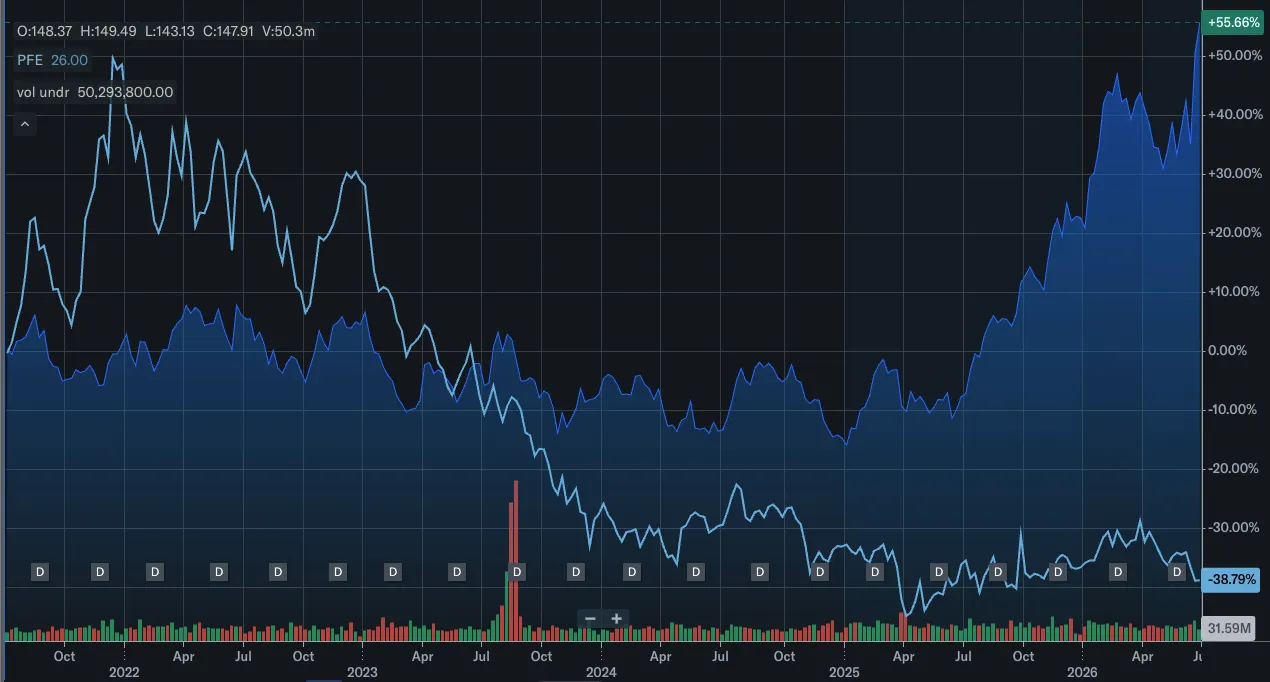
JNJ up about 56%. Pfizer down about 39%. A gap of nearly 95 percentage points in five years.
That divergence isn’t a rounding error, and it isn’t recent noise. That’s five straight years of the market pricing these two companies very differently — even though they’re both large-cap US pharma, both dividend-paying, both technically “the same industry.”
And it’s more than just a raw-return story. Even after adjusting for how much market risk each stock actually carries, JNJ has been generating real excess return over what its risk exposure alone would predict. Pfizer has been destroying value on the same measure. In finance-speak this is called Jensen’s alpha — a way to measure return earned above what risk-taking alone should have delivered. It’s the framework I’ll be walking through in detail in Friday’s piece.
The numbers below are trying to explain what the market has already been telling us.
The side-by-side that matters
What the market is paying (as of July 2026):
- Price per dollar of yearly profit — JNJ 26 · PFE 8
- Dividend yield (what you get in dividends each year as a % of what you pay for the stock) — JNJ 2.3% · PFE 7.1%
- Payout ratio (how much of the yearly profit goes out as dividends) — JNJ about 50% · PFE 131% (dividend is bigger than profit)
- Consecutive years of dividend raises — JNJ 64 (one of ~50 “Dividend Kings” — companies that have raised for 50+ straight years) · PFE 17
- Average yearly dividend raise, last 5 years — JNJ about 5-6% · PFE 2.37% (barely a raise)
What each business is actually earning:
- Latest quarter revenue growth — JNJ +9.9% · PFE +5%
- Latest quarter profit per share — JNJ $2.70 · PFE $0.75
- Full-year 2026 profit-per-share guidance — JNJ $11.55 · PFE $2.80-3.00
- Does profit cover the dividend? JNJ dividend is $5.36 out of $11.55 profit — comfortable coverage. PFE dividend is $1.72 out of $2.90 profit — tight. And this is the good year before the patent cliff hits fully.
How the stock has done recently:
- In 2025 — JNJ +45% · PFE -6% (S&P: +13%)
- Over the last 10 years — JNJ compounded at roughly 10% a year · PFE at about 2% a year (the market has been telling us who compounds and who doesn’t for a long time)
The patent cliff (when a drug’s patent expires, generic drug makers can copy it, and the original drug’s sales usually collapse within a year or two):
- PFE — about $21 billion in 2024 sales at risk. Xeljanz, Prevnar 13, and Eliquis lose patent protection in 2026; Ibrance and Xtandi in 2027. That’s roughly $17-18 billion of yearly revenue that will disappear. Pfizer has announced $5.2 billion in cost cuts, which covers less than a third of the hole. Seagen (the cancer company they bought) is targeted to add $10 billion by 2030, which covers about another third — but on a longer timeline.
- JNJ — Stelara patent expired in 2025. Stelara used to make Johnson & Johnson $10.3 billion a year. In 2025 it dropped to $6.08 billion — a 41% collapse in a single year. And JNJ’s total drug revenue still grew, because thirteen other JNJ drugs each grew by double digits. Management calls the Stelara hit “in the rearview mirror” and is now targeting $100 billion in yearly sales.
Capital return (dividends and buybacks — the cash the company sends back to shareholders):
- PFE has $43 billion tied up in the Seagen deal. Some real momentum there — one drug (Padcev) up 39% in the latest quarter. But even at full expected value, Seagen only offsets about half the coming patent cliff.
- JNJ raised its dividend 3.1% to $1.34 per quarter this past April, extending its 64-year streak. The dividend is comfortably covered by the cash the business generates.
The dividend signal test, applied to PFE
Remember the three warning flavors from the dividends piece? Here they are again — all three fit Pfizer:
1. Claiming to be a growth company while paying a big dividend. Pfizer’s management talks about their cancer pipeline, their new obesity drugs, their $43 billion Seagen bet, “the future of the company.” All growth talk. At the same time, they’re paying out $1.31 in dividends for every $1 they earn. If Pfizer is a growth company, cut the dividend and reinvest that cash into the pipeline. If Pfizer is a mature cash machine, stop pretending they’re a growth company. You cannot credibly be both.
2. Borrowing to pay the dividend. Pfizer fits this literally. Their dividend is bigger than their profits. So where does that extra money come from? Cash reserves, borrowing, or accounting adjustments. None of those are sustainable. The 2026 profit forecast of about $2.90 per share barely covers the $1.72 dividend. The 2027 picture, once the patent cliff hits fully, is worse.
3. Not being able to cut the dividend because the stock would collapse. This one is exactly what’s happening at Pfizer. Seventeen straight years of raises have attracted a specific kind of shareholder — retirees, dividend-focused funds, income strategies — who are only holding the stock because of the dividend. If Pfizer cuts, those holders sell, and the stock drops even further. Pfizer’s management is trapped by their own dividend story. The dividend has stopped being a decision about capital and started being a hostage situation. The cut is coming eventually. The only question is when.
None of this means “sell PFE tomorrow.” It means: be honest about what the 7% yield is really pricing in.
Why “cheaper” isn’t “cheap”
The temptation with a matchup like this is to buy the cheaper one. Pfizer at 8 times earnings looks like a bargain compared to JNJ at 26 times. This is exactly the mistake we walked through two weeks ago with JPM vs BAC — the market pays a premium for the more durable business, and that premium is usually earned.
Here’s the specific problem with PFE looking “cheap”:
Pfizer trades at 8 times earnings only if you use last year’s earnings — which still include the tail end of the COVID boost. Once the patents on their big drugs expire in 2026 and 2027, and $17-18 billion of yearly revenue drops off, profit drops with it. Suddenly that “8 times earnings” number becomes more like “12 times earnings” — without the stock price moving a penny. And the 7% dividend? Once profit drops that far, they literally cannot pay it from what the business makes. So either they cut the dividend, or they borrow to keep paying it. Both end badly.
JNJ at 26 times earnings looks expensive if you just glance at the number. But the market is paying that price for a reason. JNJ just went through its own patent cliff — losing $4+ billion of Stelara revenue in one year — and didn’t miss a beat. Their other 13 drugs picked up the slack. They’re targeting $100 billion in yearly sales. And they’ve raised the dividend every single year — through recessions, wars, a financial crisis, a pandemic, and multiple presidential administrations — since 1962. That’s what durability costs.
Cheaper isn’t value when the cheaper business is in the middle of a reset. That’s the same lesson from JPM vs BAC two weeks ago — applied to pharma this time.
The honest bear case for JNJ
Nothing is risk-free, and JNJ has two real problems worth naming.
Talcum powder lawsuits. Johnson & Johnson faces about 68,000 lawsuits — the largest active batch of related lawsuits in US courts. The lawsuits allege that JNJ’s old baby powder caused ovarian cancer and mesothelioma. In December 2025 a jury in Baltimore awarded $1.5 billion to one plaintiff. Other individual verdicts have been $40-65 million. JNJ tried to settle everything via bankruptcy court three times (offering $8 billion in the most recent attempt); the court rejected all three attempts. Now the company has to litigate case by case or find a global settlement through mediation. Ultimate cost is genuinely unknown — the market has been assuming somewhere between $10 and $25 billion, but individual verdicts keep coming in bigger than expected. It won’t sink Johnson & Johnson (they generate $25 billion of cash a year), but it drags on the stock and is a good reason not to own JNJ as an oversized position.
More patent cliffs coming. Stelara was JNJ’s biggest 2025-2026 problem, but they’ll face similar problems with other drugs later this decade (Darzalex, for example). Every diversified drug company faces this. JNJ has been good at replacing lost drugs with new ones, but “in the rearview mirror” is only true for the specific drug that just expired, not for the pipeline pressure that never really ends.
Neither is a reason to avoid JNJ. Both are reasons to size the position sensibly — I hold it as a core defensive stock, not a maximum bet.
The honest bull case for PFE
I’d rather be wrong about Pfizer than pretend the bull case doesn’t exist. Fair points a PFE optimist would make:
- The Seagen cancer drugs are actually delivering. Padcev up 39%, cancer biosimilars up 52% in the latest quarter. If Seagen hits its $10 billion target by 2030, that’s real.
- Obesity drug pipeline is real optionality — GLP-1 drugs (the class of Ozempic, Wegovy) are the hottest area in pharma right now, and Pfizer has candidates in development. Most fail, but some don’t.
- The 7% dividend is real cash for as long as it lasts.
- A dividend cut would actually clear the air. Counter-intuitively, when Pfizer finally cuts and does a reset, the stock could rally on the “worst news is out” trade. Some deep-value investors are betting on exactly that catalyst.
- “Left for dead pharma comes back” isn’t a zero-probability play. It’s happened before with other names. Maybe 1 in 4 times over a 10-year window. Small odds, but real.
I don’t buy PFE at any of these points because in each case the honest reply is “maybe, but that’s a lot of ifs, and there’s an easier way to own healthcare that’s compounding right now.” That easier way is JNJ.
The conviction climax
I’ve watched Pfizer for fifteen years and never bought. I’ve had multiple chances to buy at prices that looked reasonable — the pre-COVID $30s, the post-COVID crash to the $20s, the Seagen-catalyst hope in early 2024, and now a 7% dividend with a single-digit multiple. Never once. Not a single share, in a 15-year window that included some of the most volatile stretches in pharma the market has ever seen.
The reason isn’t that PFE has been a terrible stock — it’s been up about 2% a year over the last ten years, which is bad relative to the market but not a wipeout. The reason is that Pfizer has been in serial reinvention mode for most of my adult investing life. And serial reinvention is a poor substitute for compounding. Every quarterly earnings call, there’s a new “here’s the pipeline that changes everything” story. The COVID windfall wasn’t a reset — it was a temporary boost the company treated as the new base, and now spends every call explaining how they’ll replace it.
Meanwhile Johnson & Johnson has been quietly raising its dividend every single year through all of it. Sixty-four years and counting. About 5% a year on average. Always credibly, always from the strength of a diversified business that keeps growing across a dozen drugs even during its own patent-cliff years.
I first bought JNJ in April 2011 at $59.90. Today it trades at $263 — the stock alone has gone up more than 4x, and closer to 6x once you count the reinvested dividends. In January 2022 I sold about two-thirds of the position at $170 — to help pay the down payment on the house we bought that year. That’s what a mature compounded holding is FOR — not to sit in a spreadsheet as a number that keeps going up, but to convert into real life when the moment matters. The remaining shares still compound in my retirement accounts. The dividend I’ve collected on them for fifteen years has been raised every single one of those years.
That’s the difference the dividends piece was trying to teach in the abstract. Here it is in concrete numbers, in a real portfolio, over a real fifteen years.
Fresh money to JNJ. And when PFE eventually does cut the dividend — which they’ll have to, unless something surprising happens with their pipeline — the deep-value case that today’s bulls are selling will look very different than the one they’re describing. I’ll probably pass then too.
What to do about it
- 🟢 Simple: Own JNJ. Size it to whatever you’d be comfortable holding if the stock dropped 20-30% (which any big stock can, even the durable ones). Remember the talc lawsuits when you’re sizing — this is a core defensive holding, not a maximum position.
- 🟡 A bit more work: Own JNJ; pair it with one more high-quality large-cap drug or medical device company that isn’t in the middle of a patent cliff. Roche, Lilly at reasonable prices, Boston Scientific, and Danaher are all worth a look. No PFE.
- 🔴 Only if you’re experienced: If you specifically want a Pfizer turnaround bet, keep it small (under 1% of your portfolio) and know exactly what would make you sell. The classic value trap in pharma is doubling down after the dividend cut on the theory that “the bad news is out.” That’s how a small speculative bet becomes a real loss. This is not a recommendation.
My positioning
I bought my first shares of JNJ in April 2011 at $59.90 I added at $122 in June 2018, at $146 in December 2019, and at $162 in March 2021. In January 2022 I sold some at $170 to help fund the down payment on the house. The remaining shares still compound in the retirement accounts.
I have never owned Pfizer. Not one share, in fifteen years of active investing. This piece explains why.
Where am I wrong? The obvious place is that Pfizer’s cancer drugs, obesity pipeline, and eventual dividend cut trigger a cleaner turnaround than I expect — and PFE runs the “left-for-dead drug company comes back” playbook. It’s happened before with other names. If you have a stronger view on when the dividend gets cut and what happens after, I’d genuinely like to read it in the comments.
The Head-to-Head Series
If you liked this one, here are the earlier matchups — each applies the same value-investing lens to a different industry:
Apple vs. Microsoft — the flagship — reinvest vs return cash. Which capital-allocation playbook actually wins?
Dollarama vs. America’s Dollar Stores — do dollar stores have any dollars in them? A Canadian retailer against the two big US names.
O’Reilly vs. AutoZone — two elite auto-parts compounders. I own both. I believe in one of them more.
JPMorgan vs. Bank of America — for ten of the last fourteen years, BAC was the better holding. Then something changed in 2022-2023.
Coming Friday, ~1 PM EST — “The Alpha and Beta of Everything” — the two most important metrics in stock picking, and why the same lens applies to almost every decision you make. Subscribe to get it in your inbox.
Seek Value Now is published for educational and informational purposes only and is not investment advice. I may hold positions in the securities discussed. Do your own research before investing. — HG