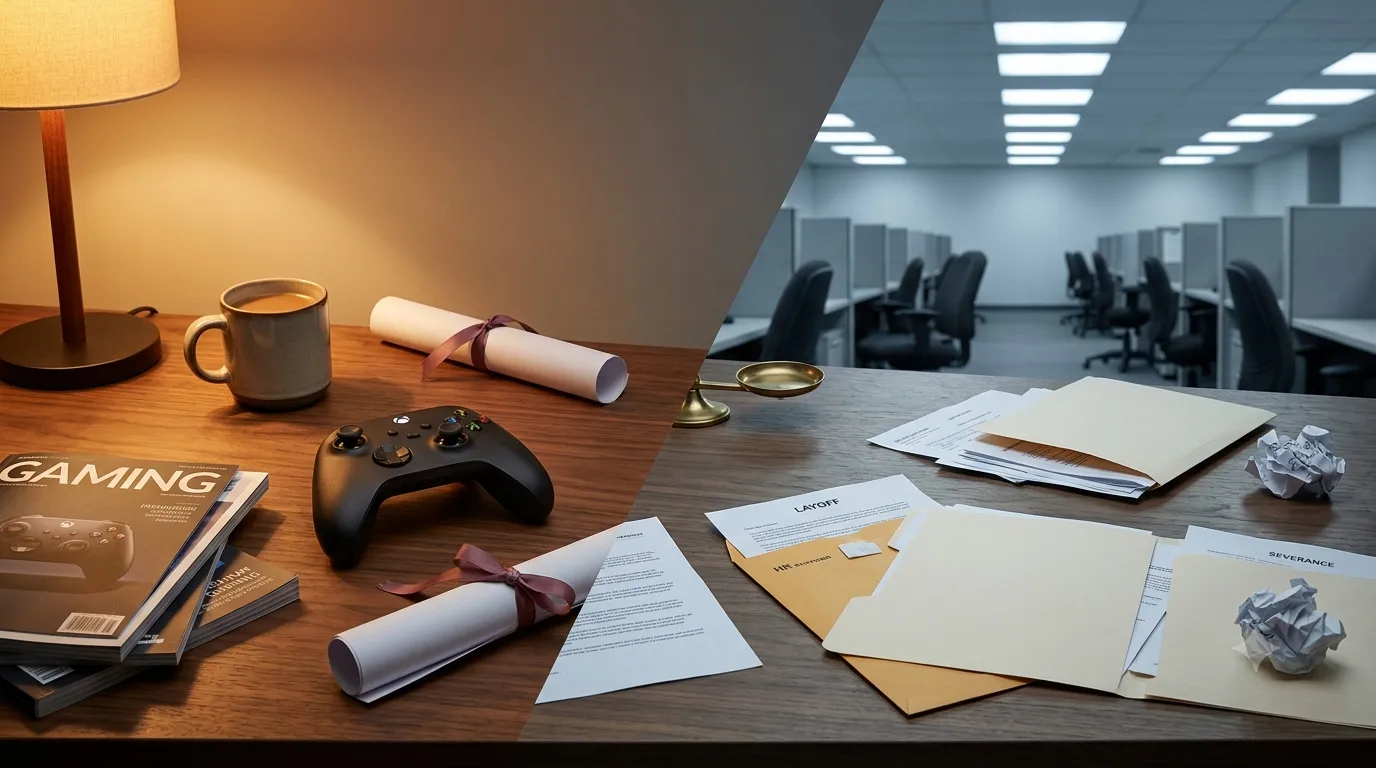
Halo, Call of Duty, Bethesda, 200 million users, 3% operating margins. Microsoft has some of the best assets in gaming, and runs them worse than anyone else could.
Disclosure: I am long Microsoft. It’s a core position in my portfolio, and it’s been in my portfolio. This isn’t a “sell Microsoft” piece. It’s a “Microsoft should finish what it started with Xbox” piece, written by an owner of the stock, watching the company do in slow motion what should have been done years ago. Full disclaimer at the bottom.
The news, in the CEO’s own words
“Our business today is not healthy.”
Those are the words of Asha Sharma, the new head of Xbox, on July 6, 2026. That was the day Microsoft announced 4,800 layoffs, roughly a third of them from her division. Sharma added that Xbox operates at margins 3 to 10 times lower than comparable platform and publishing businesses.
Read that sentence again. She wasn’t saying gaming is unhealthy. She was saying the way Microsoft runs Xbox is unhealthy, while every comparable company in the same industry is doing fine.
That distinction is the whole story. The underlying Xbox business (the studios, the brands, the games, the users) is one of the strongest collections of gaming assets on the planet. Halo. Forza. The Bethesda catalog. Call of Duty, World of Warcraft, Diablo, Candy Crush. Over 200 million monthly active users across console, PC, and mobile. A distribution footprint no gaming pure-play has matched.
Xbox is a good business. Microsoft just runs it very badly.
That’s the diagnosis, and it points at a very specific fix.
This is also what most “Xbox is struggling” coverage gets wrong. The reflex is to say gaming has peaked, the market is saturated, teenagers have moved to TikTok, kids don’t play consoles anymore. None of that is true. Gaming has never been bigger. What has failed isn’t the industry, and it isn’t the assets Microsoft owns inside that industry. It’s Microsoft’s management of those assets.
The month before, in a June 5 piece called AI promises don’t pay the GPU bills, I argued that Microsoft needed to divest its side businesses and focus. A month later, Microsoft announced layoffs, four studio spinoffs, and the biggest restructuring in Xbox history.
And as I was finalizing this piece, The Information reported that Microsoft is actively weighing three structural options for Xbox: a full spinoff into an independent public company, a joint venture with outside partners (including potential private equity involvement), or conversion into a wholly-owned subsidiary that would make an eventual sale easier. “All options are on the table,” per the internal framing quoted in the reporting.
All three are forms of divestment. Microsoft hasn’t confirmed the discussions publicly, and no specific buyer has been scouted. But this is no longer speculation from analysts. This is reporting on Microsoft’s own internal strategic conversations. It reframes what the July 6 announcements actually mean. What looked like reluctant half-measures is looking more and more like preparation for a bigger move.
This piece is the case for that bigger move, and for choosing the cleanest form of it.
Before the numbers, the picture
Three charts. Each of them makes part of the argument on its own.
Chart 1: Gaming doubled. Microsoft’s gaming revenue barely moved.
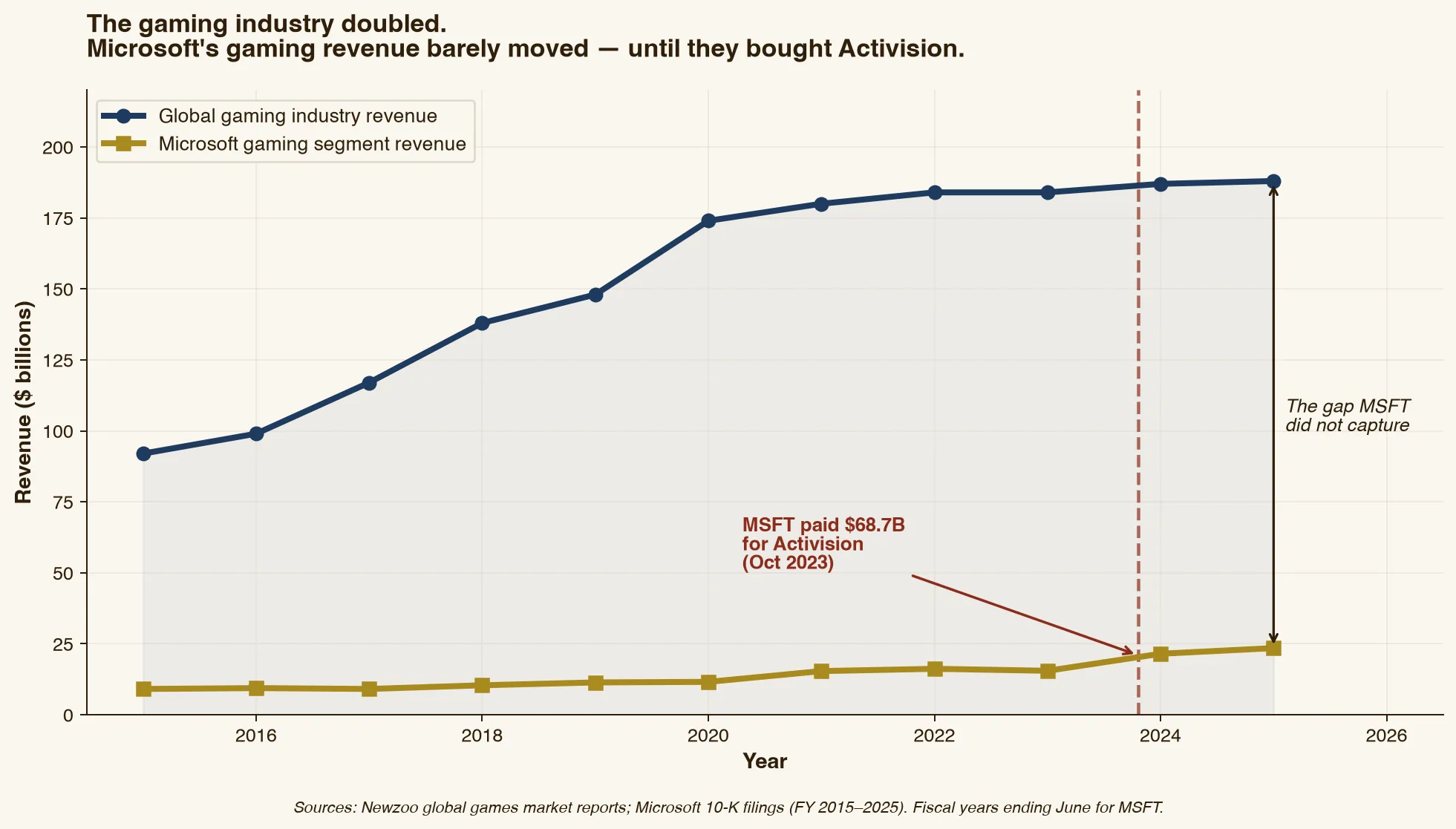
The global gaming industry went from about $92 billion in revenue in 2015 to about $188 billion in 2025. It doubled. Microsoft’s gaming segment revenue, over the same decade, crept along in the single digits of billions before suddenly jumping in 2024. That jump wasn’t organic growth. Microsoft bought that growth, paying $68.7 billion for Activision Blizzard in October 2023 and consolidating Activision’s revenue into the Xbox segment.
And this is the part that matters for the thesis. Microsoft financed the growth without a clear strategy for turning it into profits. If you strip out the Activision revenue, the underlying Microsoft gaming business was roughly flat while the industry it competes in doubled around it. If you leave the Activision revenue in, you get a segment that’s now running at 3% margins. Meaning the $68.7 billion in purchase price bought revenue but not profit. That gap (the difference between where Microsoft ended up and where the industry ended up) is the revenue Microsoft did not capture. Everyone else did. And the revenue Microsoft did buy, it doesn’t know how to monetize.
Chart 2: Every Xbox generation has sold fewer units than the last.
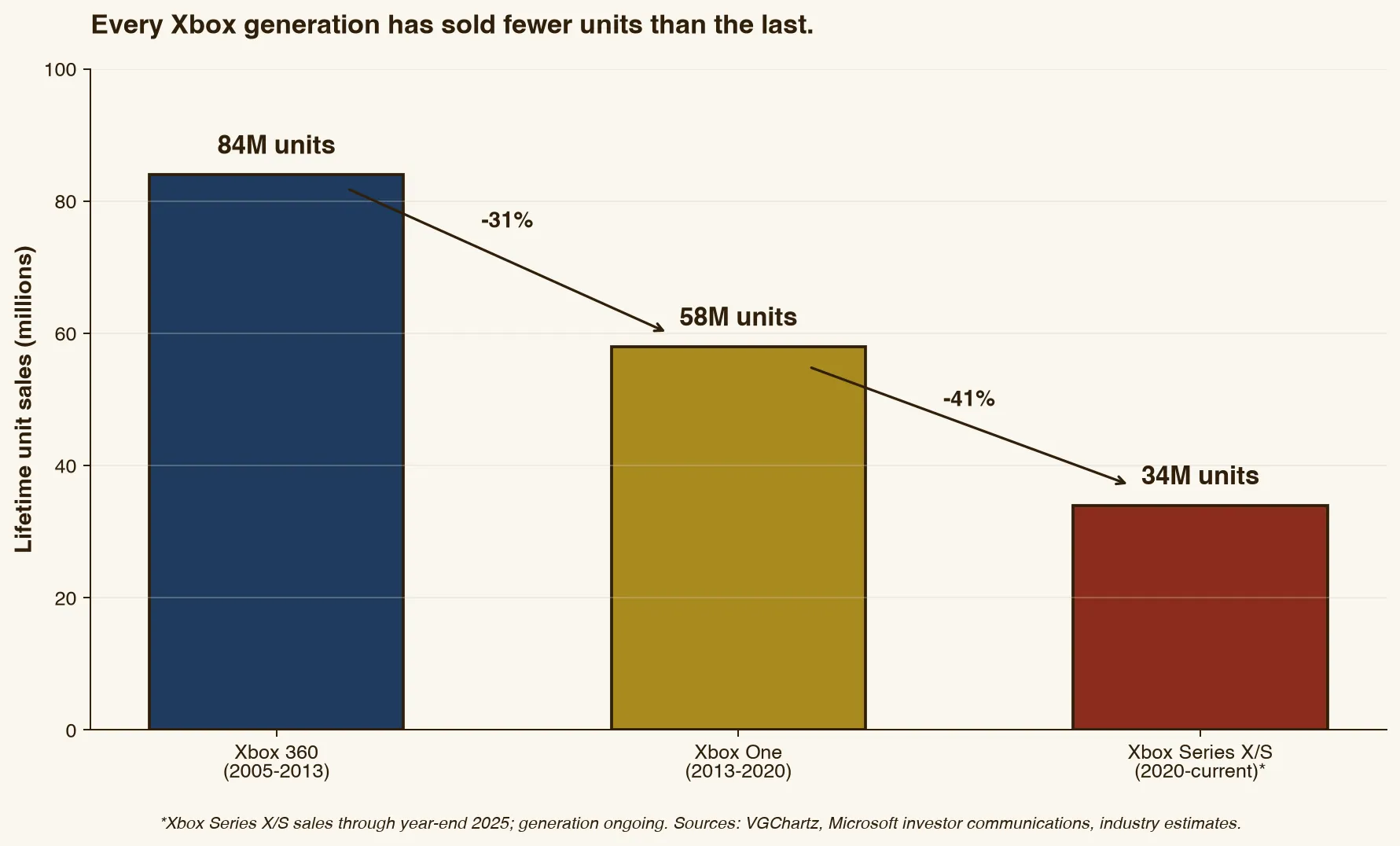
Xbox 360 (2005-2013) sold roughly 84 million units. Xbox One (2013-2020) sold 58 million, a 31% decline. Xbox Series X/S (2020-current) is on pace to finish around 34 million if the current run continues. That’s another 41% decline. Two consecutive generations of double-digit declines is not a slump. It’s a trend. And this generation isn’t over. Xbox hardware sales fell 51% year-over-year in calendar 2024 and another 32% in the most recent quarter. The floor keeps moving.
Chart 3: Xbox operates at 3% margins. Nobody else in gaming does.
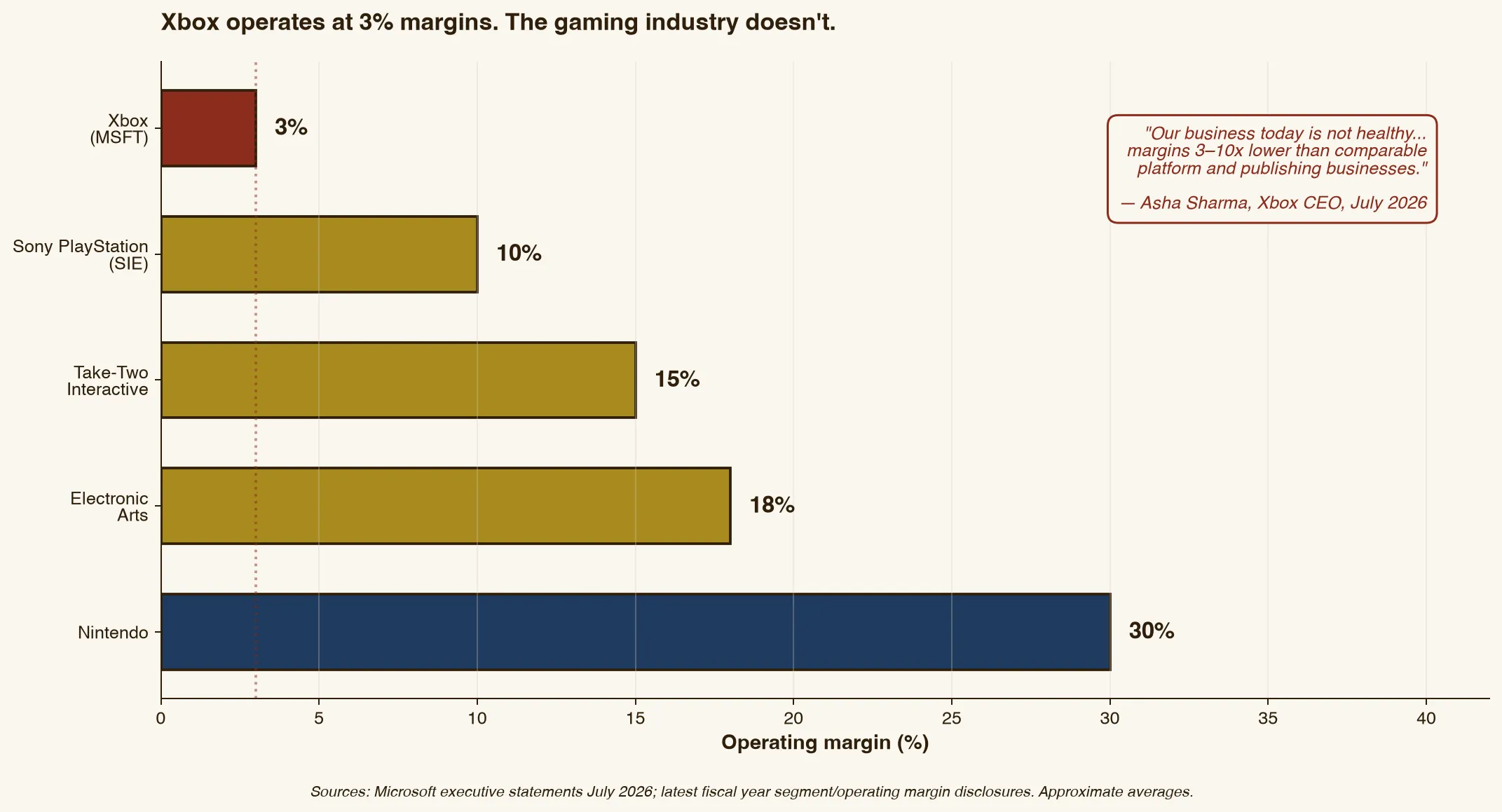
Operating margin is the share of every dollar of revenue that turns into operating profit after paying all the ordinary costs of running the business. Xbox’s operating margin, per Sharma’s own admission, is around 3%. Sony’s PlayStation runs at about 10%. Take-Two Interactive around 15%. Electronic Arts around 18%. Nintendo around 30%. When the head of Xbox says her business runs at margins “3 to 10 times lower than comparable platform and publishing businesses,” she isn’t being rhetorical. She’s giving you the number. It’s real, and it’s an admission that this problem is not the industry.
What went wrong
Now let’s look at how Microsoft got here. Three specific decisions, in roughly chronological order.
The Activision deal. In October 2023, Microsoft closed the largest acquisition in its history: $68.7 billion for Activision Blizzard, the publisher behind Call of Duty, World of Warcraft, Diablo, and Candy Crush. The initial reaction from the market was positive. The deal boosted Microsoft’s gaming revenue by 61% in the following quarter, and gave Microsoft a lineup of 20 franchises that had each generated over a billion dollars in lifetime revenue.
Here’s the part the enthusiastic coverage skipped past. In that same first full quarter of consolidation, Activision as a segment inside Microsoft generated $2 billion in revenue and a $440 million operating loss. A company that had run consistently profitable operating margins in the high 20% range as an independent business flipped to an operating loss the moment it landed inside Microsoft. Two years later, the Xbox segment as a whole is running at 3% margins. Something about how Microsoft manages this business turns profitable operations into unprofitable ones. This is a management problem, and it was a management problem the moment the deal closed. Microsoft paid a top-of-cycle price for a business it has since managed worse than the seller did.
The studio closures. In May 2024, Microsoft closed four game studios: Arkane Austin (developer of Redfall), Alpha Dog Games, Roundhouse Studios, and, most notably, Tango Gameworks. Tango Gameworks had launched Hi-Fi Rush to universal critical acclaim, attracted over three million players, and helped anchor Xbox’s 2024 multiplatform strategy. Microsoft closed them anyway. The message to every other studio inside the Xbox portfolio was unmistakable: making a critically loved game is not sufficient to keep your studio open. This is the “cutting creativity, not costs” pattern. Closing successful studios doesn’t reduce the risk of failure. It reduces the willingness of the remaining teams to take the creative risks that produce hits. In July 2026, Microsoft announced another round of studio spinoffs. The pattern is now three years running.
Game Pass hit a wall. Xbox Game Pass, Microsoft’s Netflix-style subscription service for games, was the centerpiece of the strategic case for the Activision acquisition. Internal projections disclosed during the regulatory review targeted 77 million Game Pass subscribers by July 2026 and 100 million by 2030. The actual number today is about 30 million. Game Pass peaked around 35 million in early 2024 and has since lost roughly 4 million subscribers after Microsoft raised the Ultimate tier price by nearly 50% in 2025. To miss projections by 47 million subscribers is not a rounding error. It is evidence that the subscription-first strategy, the strategy Microsoft used to justify the biggest acquisition in its history, has not worked in practice.
The Microsoft capital allocation pattern
Capital allocation is a plain phrase for a specific decision: what do you do with every dollar the business generates or borrows? Microsoft is one of the largest capital allocators in corporate history. Under Satya Nadella specifically, the company has made both good and bad calls. It’s worth looking at the pattern.
LinkedIn (bought 2016 for $26.2 billion): widely considered a great deal. Kept operationally independent from Microsoft. Jeff Weiner remained CEO, LinkedIn kept its own brand, culture, and product roadmap. Ten years later, LinkedIn quietly generates enormous revenue for Microsoft and continues to grow. The lesson: Microsoft does best when it buys a good business and leaves it alone.
GitHub (bought 2018 for $7.5 billion): followed the same playbook. Kept independent, allowed to keep its brand and culture. Successful.
Minecraft (Mojang bought 2014 for $2.5 billion): modest success. Minecraft continues to earn money because Microsoft largely left it alone.
Nokia’s phone business (bought 2014 for $9.4 billion): disaster. Folded operationally into Microsoft. Written off for $7.6 billion in fifteen months. Total losses reached about $11 billion. 27,650 jobs cut. To this day the largest single write-down in Microsoft’s history.
Activision (bought 2023 for $68.7 billion): the biggest deal Microsoft has ever done. Folded operationally into Xbox. Same trajectory as Nokia. Profitable operations in, unprofitable operations out, followed by layoffs. Microsoft hasn’t announced a writedown yet, but the pattern is the pattern.
The through-line is not subtle. Microsoft creates value when it buys well-run businesses and leaves them alone. Microsoft destroys value when it buys well-run businesses and folds them into its existing operations. Activision and Nokia are the same shape, one decade apart. If Microsoft had bought Activision and kept it operating independently, we’d be having a different conversation. Instead, Microsoft folded it into Xbox, and now the whole Xbox operation runs at 3% margins.
The bull case for Xbox (the steelman)
The honest counter-argument isn’t that any of the numbers above are wrong. The numbers are the numbers. The counter-argument is about the trajectory.
The Xbox bulls make three points, and it’s worth taking them seriously.
First: Game Pass is a long-cycle bet. Netflix took over a decade to become the dominant subscription-video business. Music streaming took similar time. The Game Pass number today (30 million) may be well below Microsoft’s projections, but so were Netflix’s numbers in year six or year eight. If Microsoft is patient, the Game Pass model may still win. The counter to the counter: Netflix wasn’t losing money every quarter as it built. Xbox is.
Second: the multiplatform pivot is a strategic reset. Starting in 2024, Microsoft ended the “Xbox console exclusive” era, putting former Xbox-only titles on PlayStation and Nintendo Switch. This is arguably the beginning of Microsoft playing a different game: becoming a publisher and platform that meets gamers where they are, rather than trying to force console adoption. If this works, Xbox’s future is more like Take-Two Interactive (15% margins) than the current 3%.
Third: Activision hasn’t fully integrated yet. M&A textbook wisdom says large acquisitions take 3 to 5 years to hit their long-term revenue and margin steady state. The Activision deal closed in Q4 2023. By that clock, we’re still in the awkward middle stretch (layoffs, restructuring, studio consolidation), and the operating margin snap-back may come later.
I don’t find any of these arguments dispositive, but I take them seriously. The base rate on very large tech acquisitions turning around after a rough integration is maybe one in three. Not zero.
What Microsoft should actually do
The answer, in one sentence: choose the full spinoff over the alternatives being weighed.
Per the reporting, Microsoft is weighing three options. A full spinoff into an independent public company. A joint venture with outside partners. Or conversion into a wholly-owned subsidiary. All three are forms of divestment. But they are not equivalent, and Microsoft’s choice among them matters enormously for shareholders and for the underlying business.
A wholly-owned subsidiary is the least disruptive path, and the weakest. It keeps Xbox inside Microsoft’s balance sheet, keeps management reporting up the same chain, and would make an eventual sale easier without actually delivering the operational independence Xbox needs. It’s the delaying tactic. It buys Microsoft time to keep hoping.
A joint venture would bring in outside capital and possibly outside management, but it introduces a partner whose interests may not align with pure gaming-focused operations. If the partner is private equity, you get financial discipline but potentially at the cost of long-term investment. If the partner is a strategic gaming operator, you may run into governance complications. Better than the subsidiary path, but not clean.
A full spinoff into an independent public company is the cleanest. Xbox becomes its own listed entity with its own management, its own capital structure, and its own investor base. An investor base that cares about gaming margins specifically, rather than about gaming’s contribution to Microsoft’s overall AI narrative. Microsoft shareholders get shares in the new entity. Microsoft’s own balance sheet is freed. The Xbox business gets the focused ownership it hasn’t had inside Microsoft.
You spin off a good business managed badly. That’s exactly what Xbox is. One outside analyst has estimated the spinoff value of Xbox today at around $97 billion, with a plausible enterprise value of over $300 billion by 2030 under a proper transformation plan run by gaming-focused operators. Even the current $97 billion is more than Microsoft paid for Activision. That gap (between what the assets are worth trapped inside Microsoft and what they could be worth run by people who genuinely care about gaming) is the value Microsoft is destroying every quarter it delays committing to the cleanest of the three options.
The most likely acquirer of a spun-off Xbox division isn’t a competitor. It’s private equity, or a strategic investor from outside gaming. A serious PE firm buying Xbox at $97 billion could impose the discipline Microsoft has been unwilling to impose. End the hardware subsidies. Run Game Pass at a profitable price point. Run the studios like a real publisher. Focus on the ten franchises that actually earn money, spin down the twenty that don’t. Xbox has not lacked capital under Microsoft. It has lacked focus. A gaming-focused owner would give it focus. And Microsoft would get $97 billion in cash to redirect into AI infrastructure, where it’s already spending $150 billion a year and, per the market’s reaction, still needs more.
The 4,800 people laid off on July 6 are the direct cost of Microsoft’s unwillingness to make this call. Every quarter of half-measures adds more names. The choice isn’t between the current path and some kinder alternative. It’s between the current path and a cleaner one.
The 4,800-person cost of delay
There is a real human cost to writing the piece I’m writing. When Microsoft cuts a job, that’s a family recalibrating on a Sunday afternoon. And a lot of those jobs were held by people who made games that shipped, that earned reviews, that got played. The Tango Gameworks team made Hi-Fi Rush. Arkane Austin shipped Redfall (fair to say a critical disappointment) but had also made Prey and Dishonored’s expansions. These are not “underperforming” people. They are people who work inside a company that decided their work wasn’t worth continuing.
The point of writing the piece is not to celebrate that outcome. The point is that a decision made two years earlier could have avoided most of it. If Microsoft had committed to divesting Xbox in 2024, when the studio closures started, when Game Pass growth stalled, when console sales fell 51%, those people would have moved to a Xbox-focused successor entity. Some of them still might. But every quarter Microsoft delays committing, more good people leave the industry entirely.
That’s the real reason the spinoff should happen now, not the marginal shareholder-value argument. Microsoft has resources and options that a Xbox-standalone company would not. Standalone Xbox has choices Microsoft-owned Xbox cannot make. The intersection of those two facts is where the value is being lost.
My positioning
I own Microsoft. It’s a core position. Xbox is a specific frustration inside that position. It’s the part of the company I would divest tomorrow if I ran it. Not because the business is broken, but because Microsoft is failing to run it. Those are two different problems with two different fixes, and Microsoft has spent the past three years trying to solve them with the wrong fix. If Microsoft announced a Xbox spinoff tomorrow, I would view it as a significant positive. If Microsoft continued the current slow-motion approach through 2027, I would view it as a modest negative for the thesis on the stock overall, but not thesis-breaking. The AI and productivity businesses are what I’m holding for.
I also wrote AI promises don’t pay the GPU bills on June 5, 2026, arguing that Microsoft should divest its side businesses. A month later, Microsoft announced the biggest Xbox restructuring in its history, four studio spinoffs, and 4,800 layoffs. Every signal short of the full call. This piece is the continued call for the same thing.
Where am I wrong? The reporting from The Information gives the “orchestrated” reading real evidence to stand on. Microsoft is genuinely weighing three real structural options, not just running Xbox on autopilot. So the pace might be less reluctant than it looked from the outside. My concern is that Microsoft’s history is to pick the least disruptive of the available options, and among the three being weighed, the wholly-owned subsidiary is the least disruptive and the weakest. If Microsoft announces a full spinoff or a genuine joint venture in the next 12 months, most of the criticism in this piece takes care of itself. If Microsoft announces the wholly-owned subsidiary and calls it a transformation, that’s the criticism this piece will sharpen into next. What’s your read on which of the three options Microsoft will actually choose?
More Microsoft & capital allocation reads
If you liked this piece, here are the earlier essays that build the same lens on Microsoft’s capital-allocation record and the broader “cheaper isn’t value” through-line.
Thesis: AI promises don’t pay the GPU bills. The piece that called for Microsoft to divest its side businesses and focus on AI. Written a month before Microsoft started doing exactly that.
Head to Head: Apple vs. Microsoft. The flagship. Two of the world’s largest companies, radically different capital-allocation playbooks. Which one wins?
Thesis: Apple: Winning by Not Losing. The counter-case. What Apple has done right by refusing to make the acquisitions its competitors have made.
Head to Head: JPMorgan vs. Bank of America. The same capital-allocation lens applied to banking. Ten of fourteen years, BAC was the better holding. Then something changed.
Coming Friday, ~1 PM EST: “Money Basics: What a market crash means when you’re 25”. Why the worst thing that can happen to a young investor’s portfolio might actually be the best thing that can happen to their long-term returns. Subscribe to get it in your inbox.
Seek Value Now is published for educational and informational purposes only and is not investment advice. I hold positions in the securities discussed. Do your own research before investing. HG